Understanding the Key Hormones Involved in the Menstrual Cycle
Downloadable Microsoft Word Version
1. The Menstrual Cycle: Big Picture
The menstrual cycle begins on the first day of bleeding (Day 1) and ends the day before the next period starts. Cycle length varies between individuals and can still be healthy if it’s consistent.
The cycle has two main hormone‑driven phases:
Follicular phase (before ovulation)
Luteal phase (after ovulation)
Ovulation is the transition point between these phases.
2. Key Hormones and What They Do
Estrogen
Rises during the follicular phase
Stimulates follicle development in the ovaries
Causes cervical mucus to become clear, stretchy, and slippery
Often linked to increased energy, focus, and sociability
Luteinizing Hormone (LH)
Stays low most of the cycle
Surges rapidly just before ovulation
Triggers the ovary to release an egg
This surge is what OPKs are designed to detect
Progesterone
Rises after ovulation
Stabilizes the uterine lining
Raises basal body temperature
Often associated with reduced energy, sleepiness, or PMS‑type symptoms
3. Ovulation: Timing vs. Confirmation
It’s important to understand the difference between predicting ovulation and confirming ovulation.
Prediction helps identify fertile days before ovulation
Confirmation verifies that ovulation already happened
No single method does both perfectly.
4. Ovulation Predictor Kits (OPKs)
What OPKs Measure
OPKs detect LH in urine. A positive result means an LH surge is occurring.
What a Positive OPK Means
Ovulation usually occurs 12–36 hours after the first positive
The fertile window is already open at the time of a positive test
A positive OPK does not confirm ovulation—only that the body is trying to ovulate
Common OPK Mistakes
Testing only once per day (LH can rise and fall quickly)
Stopping testing after the first positive
Assuming a positive guarantees ovulation (it doesn’t)
OPKs Work Best When:
Used daily (sometimes twice daily)
Combined with another method (like BBT or cervical mucus)
Tracked over multiple cycles for patterns
5. Basal Body Temperature (BBT)
What BBT Measures
BBT reflects the progesterone rise after ovulation, which slightly increases resting body temperature.
How to Take BBT
Take temperature first thing in the morning
Before getting out of bed
At the same time each day
Using a basal thermometer (two decimal places)
What to Look For
A sustained temperature rise (usually 3+ days)
Confirms ovulation happened the day before the rise
Limitations of BBT
Confirms ovulation after the fact
Can be disrupted by illness, poor sleep, alcohol, or stress
Less useful alone if cycles are very irregular
6. Putting OPKs and BBT Together
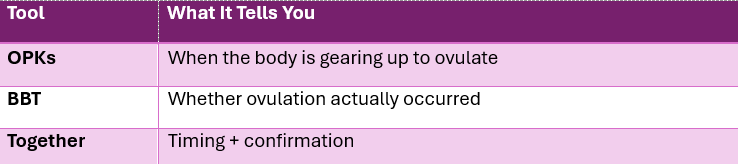
Using both methods gives a clearer picture:
Example:
OPK positive on Cycle Day 16
Temperature rise starts on Cycle Day 18
→ Ovulation likely occurred on Day 17
7. Why LH Surges Don’t Always Mean Ovulation
Sometimes the body attempts ovulation more than once in a cycle. This can happen with:
Stress
Illness
Postpartum or breastfeeding
PCOS or hormone imbalance
Coming off hormonal birth control
In these cases:
OPKs may show multiple positives
BBT helps identify which attempt was successful
8. Cycle Tracking for Health (Not Just Fertility)
Tracking can help you:
Understand PMS patterns
Identify short luteal phases
Spot irregular or absent ovulation
Prepare for medical appointments with concrete data
Helpful things to track:
Cycle length
OPK results
BBT chart
Bleeding patterns
Symptoms (mood, pain, sleep, energy)
9. When to Seek Medical Guidance
Consider discussing your charts with a clinician if you notice:
No confirmed ovulation over multiple cycles
Luteal phases consistently under ~10 days
Highly irregular cycles
Persistent severe symptoms
Tracking data helps providers interpret labs and timing more accurately.
10. Key Takeaways
LH surges trigger ovulation but don’t guarantee it
OPKs predict fertile timing
BBT confirms ovulation after it happens
Combining methods gives the most reliable insight
Patterns over time matter more than one cycle
