Understanding Your Cycle and Body Literacy
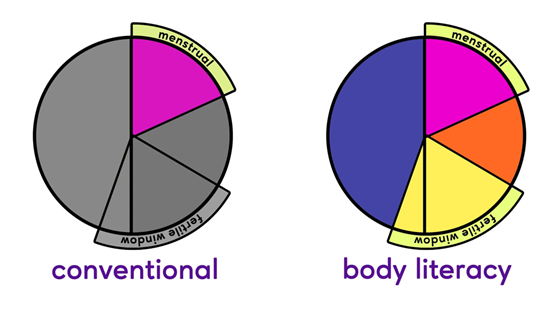
Conventional vs. body literacy perspectives on the menstrual cycle: A body-literate approach views all phases of the cycle (not only the period) as meaningful indicators of health.
Caption for image above: Conventional vs. body literacy perspectives on the menstrual cycle: A body-literate approach views all phases of the cycle (not only the period) as meaningful indicators of health.
A menstrual cycle isn’t just a monthly inconvenience – it’s a dynamic interplay of hormones and organs that reflects overall health. In each cycle, your brain, ovaries, and uterus communicate to orchestrate events: the brain’s pituitary gland releases FSH (follicle-stimulating hormone) to mature ovarian follicles; growing follicles produce estrogen; a surge of LH (luteinizing hormone) then triggers ovulation[1][2]. This cascade of hormonal signals ensures the cycle progresses through its phases. Importantly, “menstrual cycle” does not just mean your period – it encompasses the entire sequence of changes from one period to the next[3]. In a healthy cycle, all phases (menstrual, follicular, ovulatory, luteal) play a role and give insight into your well-being[3].
One key to deep cycle literacy is recognizing that “normal” doesn’t equal 28 days for everyone. In fact, menstrual cycles normally range anywhere from about 24 up to 38 days in adult women[4]. Most people do not have textbook 28-day cycles, and slight variations cycle-to-cycle are common. For example, it’s typical for cycles to be a bit irregular during the teen years after menarche and again in the 40s approaching menopause[5]. Even in the 20s and 30s, few women have cycles that start exactly the same day each month. Thus, understanding your cycle means looking at your personal pattern over time, rather than comparing strictly to an average.
Another aspect of deeper cycle understanding is seeing your cycle as a vital sign of health (similar to heart rate or blood pressure). Health experts increasingly encourage viewing the menstrual cycle as a “fifth vital sign” because cycle patterns can reflect underlying health conditions[6]. Rather than just a reproductive event, your monthly cycle is a barometer of hormonal balance, metabolic health, and more. In short, developing cycle literacy means going beyond basics – appreciating how hormonal rhythms affect your body and using that knowledge to make informed health decisions[7]. Every phase of the cycle, not just your period, can tell you something about your health[3].
Sources:
[1] [2] [4] [5]Menstrual Cycle - Women's Health Issues - Merck Manual Consumer Version
[3] [7] What Is Body Literacy? — Learn Body Literacy
https://www.learnbodyliteracy.com/what-is-body-literacy
[6] Menstrual Cycles as a Fifth Vital Sign | NICHD - Eunice Kennedy Shriver National Institute of Child Health and Human Development
https://www.nichd.nih.gov/about/org/od/directors_corner/prev_updates/menstrual-cycles
