Baby-Led Weaning: How to Cut Food Safely for Your Baby
There is something wonderfully exciting about watching a baby discover food for the first time.
The squished banana. The avocado smeared everywhere. The tiny hand grabbing a piece of broccoli and immediately dropping it.
Baby-led weaning can make those first meals feel like an adventure—but it can also make parents nervous.
One of the biggest questions is:
“How am I supposed to cut this so my baby can actually eat it safely?”
The answer depends on your baby's developmental stage, the food itself, and its texture.
And when you're feeding a baby, shape matters. A lot.
First: Is your baby ready for solids?
Most babies are ready to begin complementary foods at around 6 months, when they show developmental readiness.
Signs include being able to sit upright with good head and neck control, bringing objects to their mouth, reaching for food, and swallowing rather than automatically pushing food back out.
Readiness is more important than simply reaching a particular birthday. Babies develop at different rates.
Baby-led weaning doesn't have to mean skipping purées completely.
You can offer soft finger foods, mashed foods, purées, or a combination. The goal is to help your baby gradually learn to handle different textures and flavors while still getting the nutrition they need.
The basic rule: soft, not hard
When you're preparing food for a new eater, ask yourself:
Can my baby easily mash this with their gums?
If the answer is no, the food probably needs to be cooked, softened, mashed, shredded, or otherwise modified.
A baby's ability to chew is still developing. Even babies with several teeth don't necessarily have the chewing skills of an older child.
Foods should therefore be prepared according to your baby's developmental abilities, not simply according to whether they have teeth.
The Dietary Guidelines recommend offering foods with developmentally appropriate size and texture to reduce choking risk.
The “finger-shaped” stage
For babies who are just beginning to self-feed, the American Academy of Pediatrics recommends offering soft foods in pieces that are easy for little hands to grasp.
One useful approach is to make foods approximately finger-shaped rather than tiny cubes.
Think:
long + soft + easy to hold.
The baby can grip one end while bringing the other end toward their mouth.
Banana
Instead of:
❌ Small round coins
Try:
✅ A long, soft section of ripe banana
You can even leave some peel on one end to make it easier to hold.
Avocado
Instead of:
❌ Small slippery cubes
Try:
✅ Thick slices or wedges that are large enough for your baby to grasp
If they're too slippery, leaving some skin on one end can provide a natural handle.
Sweet potato
Instead of:
❌ Raw chunks
Try:
✅ Soft roasted or steamed wedges
The sweet potato should be soft enough to mash easily.
Broccoli
Instead of:
❌ Tiny florets that are difficult to grasp
Try:
✅ A large, very soft floret with a stem
The stem becomes a convenient handle while the baby explores the softer part.
Carrot
Instead of:
❌ Raw carrot sticks
Try:
✅ Steamed or roasted carrot sticks that are soft enough to mash
Raw carrots are a choking hazard for young children because they are hard and difficult to chew.
When should food become smaller?
As your baby develops better hand control, chewing skills, and the ability to pick up smaller pieces, food can gradually become smaller.
Eventually, you can move from larger graspable pieces to small, soft pieces.
The important thing is that there isn't one magic size that works for every baby.
Development matters.
A food that is appropriate for a 10-month-old who confidently self-feeds may not be appropriate for a 6-month-old just learning how to manage solids.
The CDC and AAP emphasize adjusting food size, shape, and texture to the child's developmental abilities.
Foods that need special attention
Some foods are particularly dangerous because they're round, firm, sticky, or difficult to break apart.
Grapes
Don't give babies whole grapes.
Instead:
Cut them lengthwise into quarters.
Whole grapes are round and slippery, which makes them a significant choking hazard.
Hot dogs
Never serve a hot dog as a round coin.
Those little circular pieces can form an airway obstruction.
If offered, prepare the food in a developmentally appropriate way and cut it into much smaller pieces as your child becomes more skilled at eating.
Nuts
Whole nuts are a choking hazard for babies and young children.
Don't give a baby whole almonds, peanuts, cashews, or other hard nuts.
Instead, nut butters can be incorporated into foods in a thinly spread or thinned form rather than given as a sticky spoonful.
A thick spoonful of peanut butter can itself be difficult for a baby to manage.
Apples
Raw apple chunks are hard and can be difficult for babies to manage.
Try cooking apple until soft or preparing it in another texture appropriate for your baby's developmental stage.
Popcorn
Popcorn is a choking hazard and should not be offered to babies or young children.
Raw vegetables
Hard raw vegetables—including raw carrots—shouldn't be offered to beginning eaters.
Cooking them until soft can dramatically change their texture and make them more appropriate.
Gagging isn't the same as choking
This distinction is incredibly important for parents practicing baby-led feeding.
Gagging is a protective reflex.
A baby may gag, cough, make noises, or bring food forward in their mouth while learning how to manage new textures.
Choking is different.
With choking, the airway is obstructed, and the baby may be unable to breathe, cry, or make normal sounds.
Parents should learn infant choking first aid and CPR before beginning solids. The AAP recommends taking a certified CPR and first-aid course.
And remember:
Supervision is part of safe feeding.
A baby should be sitting upright in a secure feeding chair or other appropriate position while eating—not lying down, walking around, or eating while distracted.
Baby-led doesn't mean baby-only
One misconception about baby-led weaning is that parents have to follow a strict set of rules.
They don't.
The AAP notes that families can adapt baby-led feeding to their individual circumstances. Purées can be nutritious, spoon-feeding can be appropriate, and some babies benefit from a combination of approaches.
The “baby-led” part is really about allowing your baby to participate in eating—to explore foods, practice feeding themselves, and gradually learn different textures.
You don't have to choose between purées OR finger foods.
You can do both.
Don't forget nutrition
There's another important piece of baby-led weaning that sometimes gets lost on social media:
Food needs to be nutritious, not just Instagram-worthy.
As babies begin eating solids, offer a variety of nutrient-dense foods, including sources of iron and other essential nutrients.
Think about foods such as:
Soft-cooked meat or shredded meat
Eggs
Beans and lentils
Iron-fortified infant cereals
Yogurt
Avocado
Soft fruits
Cooked vegetables
Whole grains
Breast milk or infant formula remains an important part of an infant's diet during this transition.
The goal isn't to replace milk overnight.
It's to gradually introduce your baby to the world of food.
The bottom line
Baby-led weaning doesn't have to be complicated.
Start with foods that are:
Soft.
Easy to grasp.
Developmentally appropriate.
Nutrient-dense.
And remember that shape and texture can matter just as much as the food itself.
A grape isn't necessarily dangerous because it's a grape.
It's dangerous when it's round, slippery, and whole.
A carrot isn't necessarily dangerous because it's a vegetable.
It's dangerous when it's hard and difficult for a baby to break down.
Changing the way a food is prepared can dramatically change how appropriate it is for a young eater.
And perhaps the most important rule of all:
Let your baby explore—but don't leave safety to chance.
Sit them upright. Stay with them while they eat. Learn infant CPR and choking first aid. Pay attention to their developmental abilities. And when you're unsure whether your baby is ready for a particular food or texture, ask their pediatrician.
Baby-led weaning isn't about proving that your baby can eat like an adult.
It's about helping your baby learn how to eat safely, confidently, and joyfully—one messy bite at a time.
Sources
American Academy of Pediatrics, Baby-Led Weaning: Is It Safe?
American Academy of Pediatrics, When Can Babies Start Solid Foods?
American Academy of Pediatrics, Choking Prevention for Babies & Children
U.S. Dietary Guidelines, Complementary Feeding and Feeding Styles and Practices During Childhood
CDC, Solid Foods in Early Care and Education
A simple food-shape cheat sheet
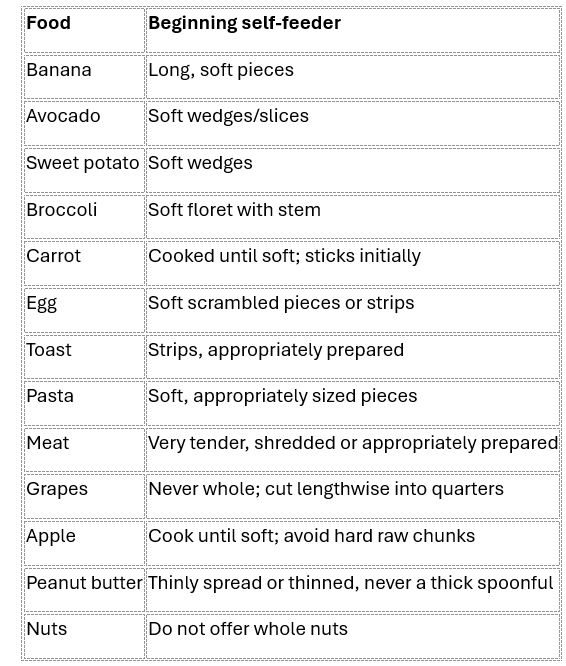
A simple food-shape cheat sheet
